
Earn (LPs)
Be the house. You deposit into the pool and it takes the other side of leveraged ETH trades, so you earn the fees traders pay to take leverage, plus the premiums and the spread as volume flows. It is an always-on, NAV-based vault (live on Base and Arbitrum): deposit or redeem any time, subject to the pool's free liquidity (see below).
   traders open leveraged ETH trades
          │  premium + fees + spread
          ▼
   ┌──────────────┐      shares
   │   the pool   │◀──────────────  you deposit (ETH / WETH / USDC)
   │ (the house)  │──────────────▶  you redeem any time*
   └──────────────┘
          │ pays out winning trades at expiry
          ▼
   * up to the pool's free (uncommitted) liquidity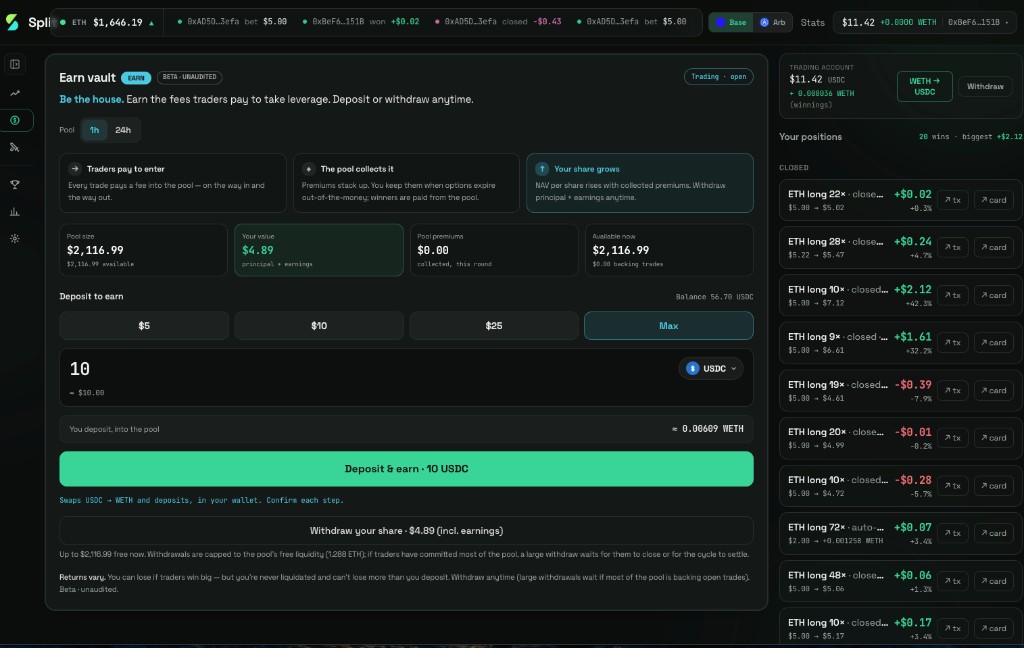
The deal in three beats
- Traders pay to enter. Every trade pays a fee into the pool, on the way in and the way out.
- The pool collects it. Premiums stack up. The pool keeps them when trades expire out of the money; winners are paid from the pool.
- Your share grows. NAV per share rises as the pool collects premiums, fees, and spread. Redeem your shares for pro-rata WETH any time the pool has free liquidity.
How it works
- Open Earn in the app.
- Deposit ETH, WETH, or USDC. USDC is swapped to WETH for you; the pool is WETH-denominated.
- Receive shares against the pool current NAV. Your shares represent your slice of pool assets plus accrued earnings.
- Redeem any time at the pool's signed NAV, paid in WETH. Deposits and redemptions work in any phase (an always-on GLP/HLP style model), but redemptions are capped to the pool's free (uncommitted) liquidity: when the book is heavily utilized you may need to redeem less or wait for traders to close.
Where the yield comes from
- Premiums. Every trade the pool writes pays a premium that accrues to the pool's NAV.
- Fees and spread. Trading fees and the bid/ask spread on volume accrue to the pool as well.
- Expired trades. When a trader's position finishes out of the money, the premium they paid stays with the pool.
The risks
| Risk | What it is |
|---|---|
| Short options exposure | The pool writes options, so a large, fast move against the book can cost more than the premiums collected over a calm stretch. |
| Directional inventory | If many traders take one side, the pool carries that exposure until expiry. |
| Gap risk | A violent gap (a fast double-digit move) is where a writing book takes its worst drawdowns. |
The premium, fees, and spread compensate writers for carrying these risks over time. Size your deposit accordingly.
What is live today
- Call / WETH pool: live on Base and Arbitrum. Deposits (ETH, WETH, or USDC) and redemptions are wired in the app. This is the pool that writes the UP (call) side.
- Put / USDC pool: writes the DOWN (put) side. Operator-seeded for now, not user-depositable from the UI yet.
- One deposit funds one side. A unified two-sided vault that underwrites both UP and DOWN from a single deposit is on the roadmap.
TIP
For the deeper economics, premium yield, drawdown behavior, gap stress, and how Split compares to other liquidity vaults, see Research.