
Open an UP position (call)
Going UP profits when ETH rises (it's a call under the hood). You pick a leverage tile, confirm, sign once, and the position (your N token) lands in your account, enrolled for auto-exercise at expiry.
 connect  ──▶  pick a tile  ──▶  confirm  ──▶  sign once  ──▶  N in Positions
 (Privy)       lev / strike      premium =      USDC pull       auto-exercise
               premium / be      max loss       (or zero)       enrolled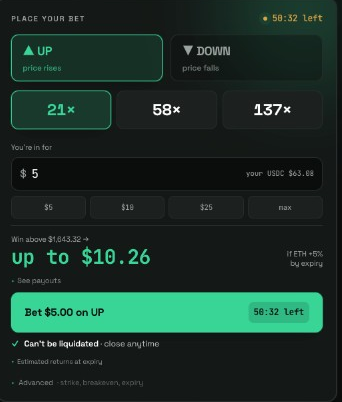
Steps
- Connect your wallet through Privy (email, social, or an existing wallet).
- Pick an UP tile. Each leverage tile (for example 21x, 58x, 137x) shows leverage, premium (your max loss), and breakeven, with strike under Advanced. Higher leverage means a strike further from spot, a cheaper premium, and a smaller cushion.
- Confirm in the Buy panel. You see exactly what you pay and the worst case before you commit.
- Sign once. A single signature authorizes the USDC pull for the premium.
- Done. N mints to your account and appears in Positions.
How one signature works
Split uses a gasless flow built on EIP-3009 (USDC signed transfer) and account abstraction:
- If your in-app trading account already holds enough USDC, the buy needs zero popups. It executes directly.
- If not, one signature pulls only the shortfall from your wallet, then the same batch approves and buys in a single transaction. You never pay gas in ETH.
The buy batch also includes a bounded approval that enrolls the position for auto-exercise, so an in-the-money call settles itself at expiry. Enrollment is best effort and never blocks your buy.
After the buy
Your position card shows leverage, premium (max loss), breakeven, and live value. To read those numbers, see Read a position.
TIP
Picking leverage: a lower-leverage (closer to the money) call wins more reliably but costs more. A higher-leverage (further out) call is cheaper with a bigger potential multiple but needs a larger move. Your breakeven (strike plus premium) tells you the move you need.
WARNING
You can trade on Base and Arbitrum. Auto-exercise currently covers UP positions on Base only. On Arbitrum, close before expiry to realize a win. See auto-exercise for the exact coverage matrix.